
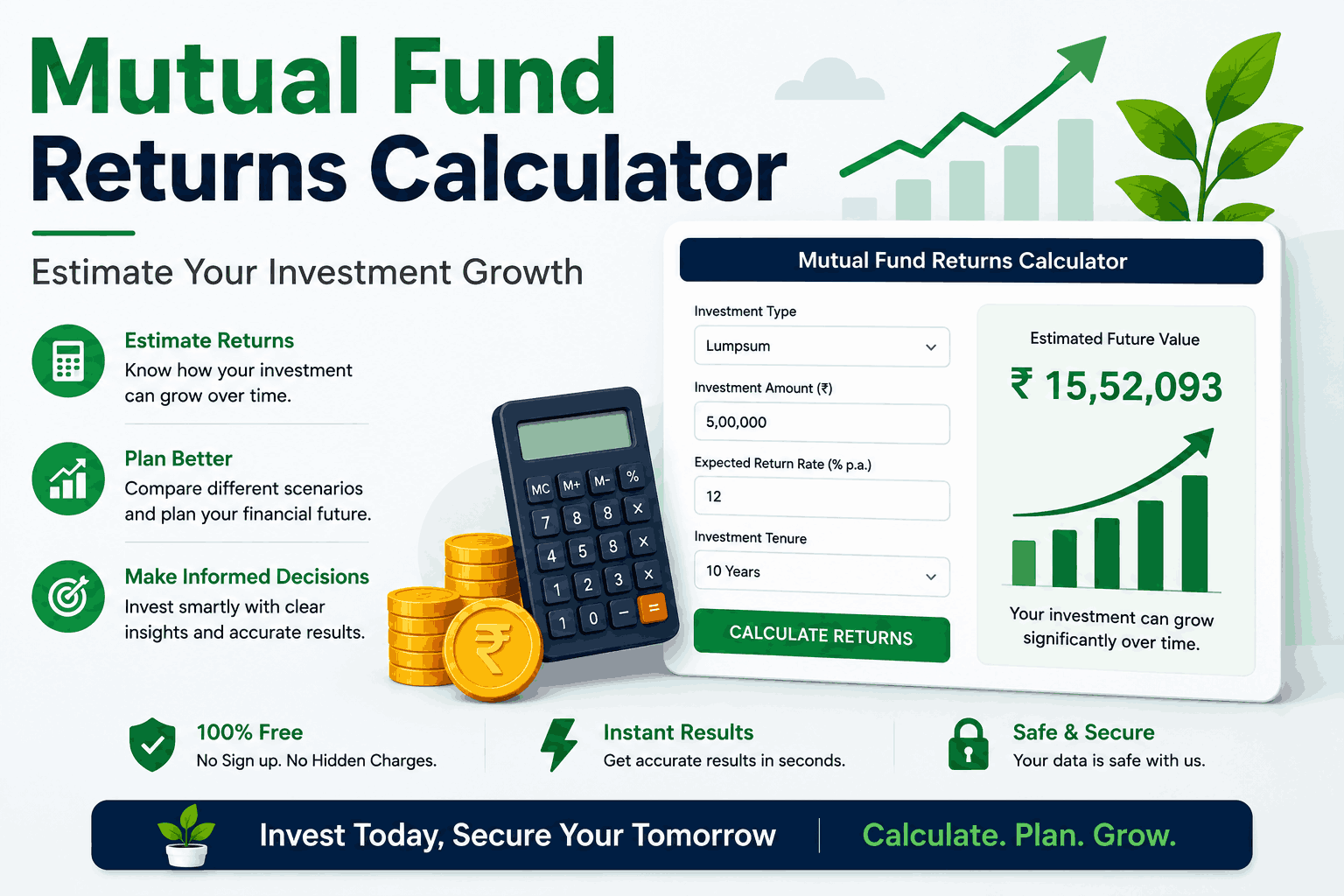
If you are investing in the Vanguard S&P 500 ETF (VOO) and want to estimate how your money could grow over time, a VOO calculator can be a useful planning tool. Instead of manually calculating investment growth, you can use a VOO investment calculator to estimate potential returns based on your initial investment, regular contributions, investment period, and an assumed annual return.
Whether you are a beginner investor planning your first $1,000 investment or an experienced investor making monthly contributions, a VOO calculator can help you understand how compound growth may affect your portfolio over the long term.
This guide explains what a VOO calculator is, how to use one, how VOO investment returns are calculated, and how to estimate your potential portfolio value.
Important: A calculator provides estimates, not guaranteed investment results. Actual VOO returns can vary significantly from year to year, and past performance does not guarantee future results.
What Is a VOO Calculator?
A VOO calculator is an online investment calculator designed to estimate how an investment in VOO could grow over a specific period.
VOO is an exchange-traded fund designed to track the S&P 500 Index. When you invest in VOO, you gain exposure to a broad group of large U.S. companies represented in the S&P 500.
A typical VOO calculator may allow you to enter:
- Initial investment
- Monthly or annual contribution
- Investment period
- Expected annual return
- Dividend reinvestment assumptions
- Inflation rate
- Contribution frequency
The calculator then estimates the potential future value of your investment.
For example, suppose you start with $10,000 and add $500 every month. If you assume a particular average annual return and continue investing for 20 years, a VOO investment calculator can estimate the value of the portfolio at the end of that period.
The result is only an illustration because the actual market does not produce the same return every year.
Why Use a VOO Investment Calculator?
Investing for decades can make it difficult to understand how relatively small contributions may accumulate over time.
A VOO calculator makes this easier by showing the potential effect of:
- Your starting investment
- Regular contributions
- Compound growth
- Investment duration
- Dividend reinvestment
- Market return assumptions
The biggest advantage is that you can experiment with different scenarios.
For example, you could compare:
- $5,000 invested once versus $5,000 plus monthly contributions
- 10 years versus 20 years
- $250 monthly contributions versus $500 monthly contributions
- Reinvesting dividends versus taking dividends as cash
This can help you understand the mathematical impact of long-term investing.
How Does a VOO Calculator Work?
Most investment calculators use a future-value formula based on compound growth.
If you make a one-time investment and assume a constant annual return, a simplified formula is:
Future Value = Initial Investment × (1 + r)ⁿ
Where:
- r = annual rate of return
- n = number of years
For example, if you invest $10,000 and assume a hypothetical 8% annual return for 20 years:
Future Value = $10,000 × (1.08)²⁰
The result represents the theoretical value if the investment earned exactly 8% every year and there were no taxes, fees, withdrawals, or other adjustments.
Real-world investment returns are not constant. Therefore, the calculator should be viewed as a planning estimate rather than a prediction.
VOO Calculator With Monthly Contributions
Many investors do not make a single investment. Instead, they invest a fixed amount every month.
This is where a VOO investment calculator with monthly contributions can become particularly useful.
For example, imagine an investor:
- Starts with $5,000
- Invests $300 per month
- Invests for 25 years
- Assumes a hypothetical average annual return
The calculator can estimate both the amount contributed and the potential investment growth.
Your total contributions would be:
Initial investment + monthly contributions × number of months
The difference between total contributions and estimated portfolio value represents the hypothetical investment growth.
This distinction is important because a portfolio’s final value does not consist entirely of money you personally contributed.
VOO Compound Interest Calculator
A VOO compound interest calculator focuses on the effect of earning returns on previously accumulated returns.
Compound growth can become increasingly important as the investment period becomes longer.
Consider a simplified example.
Suppose you invest $10,000 and earn a hypothetical 8% annual return.
After one year, the investment could become approximately $10,800.
If the following year also produced 8%, the return would be calculated on $10,800 rather than the original $10,000.
Over multiple decades, this compounding effect can become substantial.
However, stock-market returns do not actually compound at a fixed rate every year. The value of VOO can rise and fall, and actual returns can differ considerably from any calculator assumption.
VOO Return Calculator
A VOO return calculator can be used to estimate investment performance over a selected period.
There are two important concepts to understand:
Total Return
Total return generally considers both:
- Changes in the investment’s market value
- Dividends received
For a dividend-paying ETF such as VOO, looking only at the change in share price may not provide a complete picture of an investor’s total return.
Price Return
Price return focuses on the change in the market price of the investment and does not include dividends.
When comparing long-term investment performance, investors often pay attention to total return because dividends can contribute to overall investment results.
VOO Dividend Calculator
VOO also distributes dividends, so some investors search specifically for a VOO dividend calculator.
A dividend calculator can estimate potential dividend income based on:
- Number of shares owned
- Dividend per share
- Dividend frequency
- Assumed dividend growth
- Dividend reinvestment
A simplified dividend calculation is:
Estimated Dividend Income = Number of Shares × Dividend Per Share
For example, if you owned 100 shares and the dividend were hypothetically $1 per share for a particular distribution:
100 × $1 = $100
Actual distributions can change, so historical dividend amounts should not automatically be treated as future payments.
Dividend Reinvestment
One important feature to consider is dividend reinvestment.
Instead of receiving dividends as cash, an investor may use them to purchase additional shares or fractional shares, depending on the brokerage.
Those additional shares can potentially generate future dividends, creating another source of compounding.
A VOO calculator that includes dividend reinvestment can therefore produce a different estimate from one that assumes dividends are taken as cash.
VOO Growth Calculator
A VOO growth calculator can help investors visualize potential portfolio growth over different periods.
For example, you might enter:
| Input | Example |
| Initial investment | $10,000 |
| Monthly contribution | $500 |
| Investment period | 20 years |
| Hypothetical annual return | 8% |
| Dividend reinvestment | Yes |
The calculator can then estimate the potential future portfolio value.
You can change any of these inputs to create different scenarios.
For example, increasing the monthly contribution from $500 to $750 may have a meaningful effect over 20 years because the additional money also has more time to potentially compound.
VOO Calculator for $1,000 Investment
A common question is:
“What could $1,000 invested in VOO become?”
There is no single answer because it depends on:
- When the investment was made
- How long it remains invested
- Market performance
- Dividend distributions
- Whether dividends are reinvested
- Taxes and investment costs
A calculator can illustrate hypothetical scenarios.
For example, if $1,000 were invested for 20 years at an assumed annual return of 7%, the mathematical estimate would be:
$1,000 × (1.07)²⁰
The result is an illustration of compound growth under a constant assumed return. It should not be interpreted as a forecast of what VOO will actually return.
VOO Calculator for Monthly Investments
Regular investing is another scenario worth modeling.
Suppose you invest:
$200 per month
for:
30 years
A VOO calculator can estimate how much you contributed versus how much the portfolio might theoretically be worth under different return assumptions.
You can also test several monthly contribution levels:
- $100 per month
- $200 per month
- $300 per month
- $500 per month
- $1,000 per month
This makes it easier to see how changing the contribution amount could affect the mathematical outcome.
For many long-term investors, the contribution rate can be just as important to understand as the assumed investment return.
How Accurate Is a VOO Calculator?
A VOO calculator is mathematically accurate based on the numbers you enter, but that does not mean its future-value estimate will actually occur.
The main limitation is the assumed rate of return.
For example, a calculator may assume an 8% annual return for 30 years. In reality, the stock market could produce:
- Positive returns in some years
- Negative returns in other years
- Very high returns in certain periods
- Very low or flat returns during other periods
The actual sequence of returns matters.
Therefore, it can be useful to run several scenarios rather than relying on a single return assumption.
For example:
Conservative scenario: lower assumed return
Moderate scenario: middle assumed return
Higher-growth scenario: higher assumed return
These scenarios are not predictions. They simply demonstrate how different assumptions change the mathematical outcome.
VOO Calculator and Inflation
Another important factor is inflation.
If your calculator shows that an investment could grow to $500,000 in the future, that $500,000 will not necessarily have the same purchasing power as $500,000 today.
An advanced VOO calculator may allow you to enter an inflation assumption.
A simplified real-return calculation can be expressed as:
Real Return ≈ (1 + Nominal Return) ÷ (1 + Inflation Rate) − 1
For example, if the hypothetical nominal return is 8% and inflation is 3%, the inflation-adjusted return would be lower than 8%.
This is why long-term financial planning should consider both future account value and future purchasing power.
VOO Calculator: Taxes and Fees
A basic VOO calculator may not include every cost associated with investing.
Depending on your situation, you may need to consider:
- Taxes
- Brokerage costs
- Account fees
- Currency conversion costs
- Dividend taxation
- Capital gains taxation
Tax treatment can also differ depending on your country, account type, and personal circumstances.
If you are investing in VOO from outside the United States, tax considerations can be particularly important. Investors should research the rules applicable to their own country and consider consulting a qualified tax professional where appropriate.
VOO Calculator vs. S&P 500 Calculator
Because VOO tracks the S&P 500, you may see calculators described as:
- VOO calculator
- S&P 500 calculator
- S&P 500 investment calculator
- VOO return calculator
- VOO growth calculator
These tools can be similar, but they are not necessarily identical.
VOO is a specific ETF with its own expense ratio, dividend distributions, trading price, and fund structure.
An S&P 500 calculator may instead model the performance of an index or a hypothetical index investment.
When using historical data, make sure you understand whether the calculator is using:
- Price returns
- Total returns
- Dividend reinvestment
- Inflation-adjusted returns
- Actual VOO historical data
This can make a substantial difference to the result.
How to Use a VOO Calculator
Using a VOO calculator is generally straightforward.
Step 1: Enter Your Initial Investment
Enter the amount you plan to invest initially.
For example:
$10,000
Step 2: Add Your Regular Contribution
If you invest monthly, enter your planned monthly contribution.
For example:
$500 per month
Step 3: Choose the Investment Period
Enter how long you expect to remain invested.
Examples include:
- 5 years
- 10 years
- 20 years
- 30 years
Step 4: Select an Assumed Return
Enter a hypothetical annual return.
Rather than relying on one number, consider testing multiple assumptions.
Step 5: Include Dividends if Supported
If the calculator provides a dividend-reinvestment option, determine whether you want to model reinvested dividends or cash distributions.
Step 6: Consider Inflation
For long-term planning, an inflation-adjusted calculation may provide additional context.
Step 7: Compare Scenarios
Change your contribution amount, time horizon, and return assumptions to see how the results change.
Frequently Asked Questions About VOO Calculator
What is the best VOO calculator?
There is no single calculator that is appropriate for every investor. A useful calculator should clearly explain its assumptions and allow you to adjust variables such as initial investment, contributions, time horizon, return assumptions, dividends, and inflation.
Can a VOO calculator predict future returns?
No. A calculator can estimate hypothetical outcomes based on assumptions, but it cannot predict future market performance.
Does a VOO calculator include dividends?
Some calculators include dividends and dividend reinvestment, while others focus primarily on price appreciation. Always check the calculator’s methodology.
Can I calculate monthly VOO investments?
Yes. Many investment calculators allow you to enter a recurring monthly contribution and estimate the potential future value.
Can I calculate VOO dividends?
Yes. A VOO dividend calculator can estimate dividend income using the number of shares and an assumed dividend amount. Actual future distributions can change.
Does VOO compound monthly?
The mathematics used by a calculator may model monthly compounding, annual compounding, or another convention. Actual ETF returns are driven by market price changes and distributions rather than a fixed bank-account-style interest rate.
Is VOO a guaranteed investment?
No. VOO is an equity investment and its market value can decline. Investors can lose money, including some or all of their invested capital.
Final Thoughts on Using a VOO Calculator
A VOO calculator can be a valuable way to understand the potential mathematics of long-term investing.
By entering your initial investment, monthly contributions, investment period, assumed return, dividend reinvestment, and inflation assumptions, you can create different hypothetical scenarios and see how each variable affects the estimated future value.
The most important thing to remember is that the result is an estimate, not a promise. Stock-market returns fluctuate, dividends can change, and actual investment results can differ significantly from calculator projections.
For better planning, consider running multiple scenarios instead of relying on one expected return. You can also compare the amount you contribute with the hypothetical investment growth to understand how compound growth may affect your portfolio over time.
If you are building a long-term investment plan, a VOO calculator can therefore serve as a starting point for understanding potential growth, setting contribution goals, and exploring different investment horizons.
SEO Keywords: VOO calculator, VOO investment calculator, VOO return calculator, VOO growth calculator, VOO dividend calculator, VOO compound interest calculator, VOO calculator with monthly contributions, S&P 500 calculator, VOO investment return calculator, VOO future value calculator.